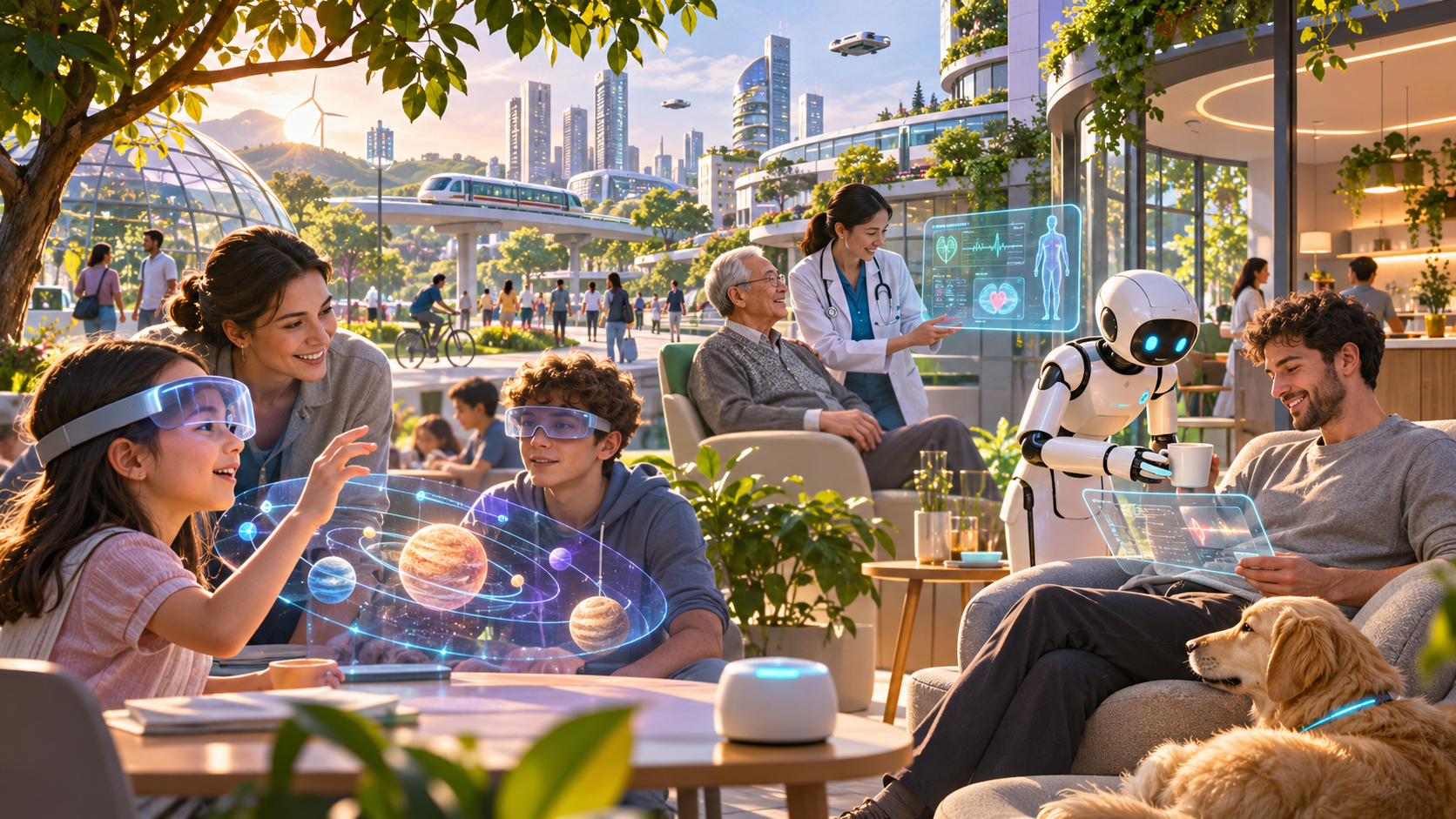
From a scientific experiment in the 1950s to a technology that could reshape civilization, artificial intelligence is entering its most important chapter.
A Brief Look Back
In 1950, British mathematician Alan Turing raised a fascinating question: Could machines think?
Six years later, scientists gathered at Dartmouth College and established artificial intelligence as a field of research. Their ambition was to create machines capable of performing tasks that ordinarily required human intelligence.
Progress was slow. Early computers could solve mathematical problems and follow instructions, but they lacked the processing power and information necessary for more sophisticated reasoning.
By the 1980s, computers were being programmed to imitate expert decision-making. During the 1990s and 2000s, machine learning allowed computers to recognize patterns and improve through experience.
Then came the breakthroughs in deep learning, followed by the introduction of ChatGPT in 2022. Suddenly, millions of people could communicate directly with artificial intelligence using ordinary language.
What had taken more than 70 years to develop was becoming part of everyday life.
Where We Stand Today
In 2026, artificial intelligence is no longer simply a scientific curiosity. It is becoming a practical tool used in medicine, education, business, science, government, and personal communication.
AI can analyze documents, write computer programs, assist medical research, create images, translate languages, and help people explore complicated subjects.
We are also beginning to see AI systems that can perform sequences of tasks rather than merely answer questions.
Yet today’s AI remains imperfect. It can make mistakes, misunderstand information, and produce convincing answers that are incorrect.
It is remarkably capable, but it is not a substitute for human judgment.
And perhaps most importantly, we are still in the early stages of understanding what this technology will eventually become.
The Future: Beyond the Computer Screen
Consider what artificial intelligence might look like 10 or 20 years from now.
Instead of opening a computer and giving an AI system individual instructions, we may have intelligent assistants capable of managing complicated activities through ordinary conversation.
A personal assistant might coordinate appointments, organize financial information, research major purchases, communicate with service providers, and help people navigate government and healthcare systems.
For elderly individuals and people living with disabilities, these capabilities could be particularly meaningful. AI could help people maintain independence, communicate more easily, and remain active in their communities.
In education, every student could potentially have access to a personalized tutor. Children who struggle in traditional classrooms might receive instruction adapted to their individual learning needs.
In medicine, AI could accelerate the discovery of treatments, identify diseases earlier, and help physicians develop more individualized care.
Scientific research could advance at an extraordinary pace. Problems involving energy, agriculture, climate, and materials development might become easier to investigate.
Robotics could extend artificial intelligence into the physical world, helping operate factories, maintain infrastructure, care for vulnerable individuals, and perform dangerous work.
These developments are possibilities, not promises. Some may arrive quickly; others may take decades or prove much harder than expected.
Nevertheless, their combined potential is enormous.
What Happens to Human Employment?
Every major technological revolution has changed the nature of work.
Agricultural machinery reduced the need for farm labor. Industrial machines transformed manufacturing. Computers eliminated some occupations while creating entirely new industries.
Artificial intelligence may produce an even broader transition because it can affect intellectual as well as physical work.
Accountants, programmers, attorneys, educators, researchers, and administrators may find portions of their jobs increasingly automated.
That does not necessarily mean these professions will disappear. More likely, many will change significantly.
Some new occupations will emerge, while others may become unnecessary.
The real challenge will be ensuring that productivity gains improve the lives of ordinary people rather than simply increasing corporate profits.
If artificial intelligence allows society to produce more goods and services with fewer working hours, could people eventually enjoy shorter workweeks, greater economic security, and more time for family, education, and recreation?
That possibility deserves serious consideration.
Who Will Control Artificial Intelligence?
Perhaps the greatest question surrounding AI is not technological at all.
It is political, economic, and philosophical.
Who will control increasingly intelligent systems?
Will a handful of enormous corporations dominate the technology, accumulating wealth and influence beyond anything we have previously witnessed?
Will governments use AI to improve public services, or will some use it to expand surveillance and control?
Will artificial intelligence strengthen democracy by giving citizens better access to information, or weaken it through sophisticated propaganda and misinformation?
These are not questions we can afford to postpone.
The decisions made over the next decade could influence the distribution of wealth, the protection of personal freedom, and the balance of power between individuals, corporations, and governments for generations.
Artificial intelligence should not become a tool that concentrates authority in fewer hands. Its greatest promise lies in distributing knowledge, capability, and opportunity more widely.
Looking Toward 2040 and Beyond
Some researchers believe artificial general intelligence — systems capable of performing a broad range of intellectual tasks at or above human levels — may eventually become possible.
Others believe achieving such capabilities will require fundamental breakthroughs that have not yet occurred.
Nobody can reliably predict when, or even whether, that milestone will be reached.
But we do not need superintelligent machines for AI to profoundly change civilization.
Even steady improvements in today’s technology could transform how we work, learn, communicate, and conduct scientific research.
Imagine a world in which language barriers become insignificant, medical knowledge becomes more accessible, and intelligent assistance is available to nearly everyone.
Now imagine the opposite: a world where the same technology is used to manipulate populations, eliminate economic opportunities, and concentrate political power.
Both possibilities deserve our attention.
The Choice Is Ours
Artificial intelligence began as an attempt to understand whether machines could imitate human intelligence.
Today, it is becoming a technology capable of extending human abilities.
Tomorrow, it could become one of the most influential forces in human history.
But technological progress does not automatically produce social progress.
We will need thoughtful regulation, public education, scientific openness, economic adaptation, and democratic accountability.
The objective should not simply be to create more powerful machines.
It should be to create a society in which increasingly powerful machines help human beings live better, healthier, freer, and more fulfilling lives.
Artificial intelligence has spent more than seven decades developing.
Its most consequential years may still lie ahead.
And ultimately, the future of artificial intelligence should remain a human decision.
Leave a Reply